

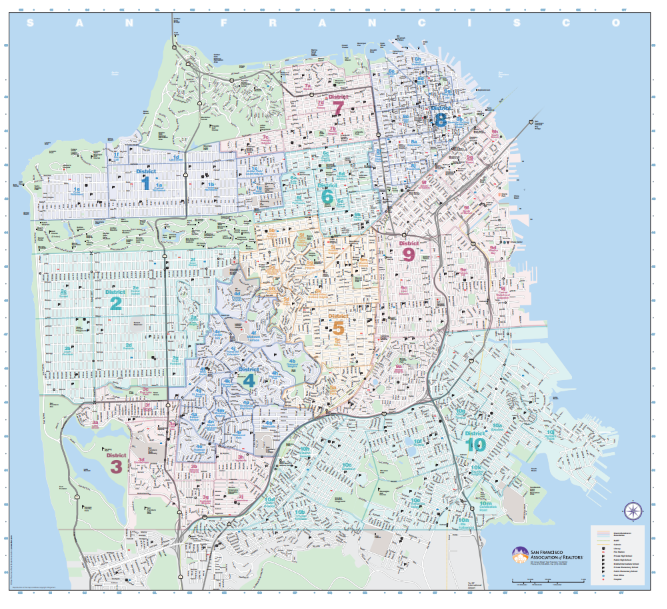
San Francisco Association of REALTORS® MLS district map, showing the city’s 10 real estate districts. Source: San Francisco Association of REALTORS® MLS.
San Francisco, CA — After months of searching, you finally find a San Francisco home that feels perfect. It is listed a few hundred thousand dollars below your approved budget, so you believe you have some room to compete. You work with your Realtor and other advisors to submit the strongest offer you can responsibly make — well above the listing price.
Then you learn that the seller accepted another offer, sometimes for hundreds of thousands — or even more than $1 million — over asking and well beyond what you could afford. Just like that, your heart drops.
If this has happened to you, you are not alone.
San Francisco remains an extremely competitive market. According to Redfin’s San Francisco housing-market data, many homes continue to sell above their asking prices and move quickly. However, the amount over asking does not tell the entire story. In San Francisco, the listing price is often part of the marketing strategy rather than a reliable statement of a property’s market value.
That lack of transparency can make buyers feel as though they stand no chance against the odds, or that they must overpay in order to win. Neither conclusion is necessarily true.
Yes, you may not win every offer, but I believe that you can approach the market more strategically and improve your chances of snagging your dream San Francisco home. Here are three ways to improve your chances without losing sight of your budget or what you truly need from a home.
1. Decide What the Property Is Worth to You Before You Offer
Before writing an offer, separate what you want from what you truly need.
Only you—and anyone purchasing the home with you—can define your non-negotiables. What is the maximum monthly payment you would feel comfortable carrying? How many bedrooms and bathrooms does your household actually need? How important is your commute, location, outdoor space, or proximity to family?
Then consider what you could live without. Would you accept an outdated kitchen, one fewer bathroom, or an architectural style that is not your favorite if the home otherwise met your needs?
This distinction becomes especially important during a bidding war. It is easy to become emotionally attached to a property and raise your offer simply because someone else wants it too. Knowing your priorities beforehand will help you recognize which homes are worth pursuing—and when it is better to walk away.
Next, determine what the property is worth based on comparable sales, its condition, the disclosures, expected repairs, and your overall financial comfort. Work with your Realtor, lender, and other appropriate advisors to establish an absolute ceiling before the offer deadline.
Just because you are preapproved for a loan that could allow you to purchase a $2 million home does not necessarily mean you should spend that much. Leaving room in your budget can provide valuable flexibility for repairs, insurance, property taxes, maintenance, and other expenses that may arise after closing.
You can also look for signs of competition. How busy were the open houses? How many disclosure packages were requested? Has the listing agent received other offers? These signals are not guarantees, but they can help you make a more informed decision.
If you love a property, it may still be worthwhile to submit an offer even when you are uncertain about the competition. The goal is not to bid on every available home. It is to identify the homes you could genuinely see yourself living in and offer only what you can defend financially and emotionally.
If another buyer outbids you, try not to treat it as proof that you cannot buy in San Francisco. Stay disciplined and keep looking.
You do not need to win every offer. You only need to win the right home.
2. Investigate the Listings Other Buyers Have Passed Over
New listings often receive the most attention, particularly when they are beautifully staged and marketed. Older listings may offer another path to finding the right home—but only after you understand why they have remained available and determine that those issues are not dealbreakers for you.

A three-bedroom, three-bathroom condominium in Daly City that was listed earlier this year. Photo courtesy of Sequoia Real Estate.
A home may have been sitting on the market because it needs significant repairs, is priced too high, has an unusual layout, includes an existing tenant, or presents another complication. Some of those issues may be dealbreakers. Others may create an opportunity for the right buyer.
For example, someone with construction experience may be comfortable purchasing a home with an outdated kitchen or deferred maintenance. A buyer who needs a move-in-ready property, however, could spend considerably more after closing if they purchase that same home and then have to manage extensive repairs.
Before dismissing or pursuing an older listing, ask:
Why has the property remained on the market?
Has a previous transaction fallen through? If so, why?
What repairs are likely to be needed?
Is the seller open to negotiating the price or other terms?
Are there legal, insurance, financing, or occupancy concerns?
If you are working with a Realtor, ask them to contact the listing agent and help you investigate. Most importantly, review the disclosure package carefully. Inspection reports, seller disclosures, permit information, and other documents may answer many of your initial questions—or reveal new ones that require further investigation.
The California Department of Real Estate’s (DRE’s) information for homebuyers reminds buyers to read the documents involved in a transaction and seek professional guidance when they do not understand something.
In 2026, AI tools can also help you organize a large disclosure package, define unfamiliar terminology, or create a list of follow-up questions. However, they can also miss context, misunderstand documents, or produce incorrect conclusions. As the saying goes, “garbage in, garbage out.” An AI-generated summary is only as useful as the information provided to it, and it should not replace advice from qualified real estate, inspection, lending, insurance, or legal professionals.
An experienced local Realtor can help identify which findings are common for homes of a similar age and which may warrant closer attention. Just as importantly, remember that a disclosure package may not contain every fact that could affect your decision. You may need additional inspections, insurance research, permit review, professional estimates, or legal advice depending on the property.
An overlooked listing is not automatically a bargain. However, careful investigation may reveal possibilities that are less obvious and less competitive than the newest listings of the week.
3. Broaden the Property Type, Not Your Most Important Boundaries
Many buyers begin their search focused exclusively on single-family homes. Depending on your needs, it may be worth considering condominiums, tenancy-in-common properties, duplexes, or other small multifamily buildings.
Each property type involves different tradeoffs.
Condominiums are sometimes dismissed because of homeowners association dues. However, those dues may cover expenses that a single-family homeowner would otherwise pay directly, such as building insurance, exterior maintenance, roofing, drainage, or common-area repairs. The important question is not simply whether there is an HOA fee. You also need to understand what it covers and review the association’s budget, reserves, insurance, and building history.
A duplex may offer the possibility of living in one unit while receiving income from the other. However, tenant-occupied buildings require additional legal and financial due diligence, particularly in San Francisco. Buyers should never assume that an occupied unit can immediately be delivered vacant or rented at a different rate. An attorney, lender, and other experienced real estate professionals can help you evaluate the particular property before you proceed.
Expanding the types of properties you consider can create more choices. However, it should not require abandoning the things you absolutely need or accepting risks you do not understand.
The Goal Is Not Simply to Win
Losing an offer is frustrating, especially after investing time and emotion in a property. But winning the wrong home—or agreeing to a price and terms that make you uncomfortable—can be far more costly.
A successful San Francisco home search requires patience, research, and a clear understanding of your own boundaries. Pay attention to the market, investigate the properties other buyers overlook, and remain open-minded about what your future home might look like.
The goal is not to win every house. It is to find the right home on terms you can live with.
Have you been outbid, confused by a listing price, or surprised by something you encountered during a San Francisco home search? I would love to hear what happened.
Thinking about buying in San Francisco? Let’s talk through your priorities and develop a strategy that fits your actual needs.
This article provides general educational information and is not legal, lending, or financial advice. Every property and transaction is different.
Jessica J. Ho is a REALTOR® based in San Francisco. California DRE #02251177.